








Digitalization best practices: measure digital maturity and transform successfully
How to measure your digital maturity — and how to transform from there. Best practices, common pitfalls, and the PASSION4IT Digital Check as investment protection.
The honest answer to “How digital is my company?” for most mid-market businesses is: you don’t really know. And that’s exactly where the problem begins. Anyone investing in digitalization without a baseline most likely ends up building an investment ruin.
Especially at the start of the digitalization journey, a solid orientation is critical. This article is written for managing directors and decision-makers in the manufacturing Mittelstand (50 to 600 employees) who need clarity about their digital maturity.
The central insight: many digitalization projects fail. The causes are rarely technical. They lie in unclear goals, missing leadership, and insufficient preparation.
Understanding digital maturity
Digital maturity is the measurable assessment of how far a company has progressed in organization, processes, and IT structures regarding digitalization. It’s not only about technology — also about culture, leadership, governance, and employee skills.
According to the 2024/25 digitalization study, about 71 % of surveyed SMEs have no documented digital strategy. At the same time, 82 % state that digital transformation is essential for their survival.
The pillars of digital maturity
Organizational maturity covers structure, leadership roles, change capacity, and innovation culture. Leadership must lead the digital change. Without visible commitment from the top, digitalization projects fail consistently.
Process maturity refers to how well processes are documented, digitized, and automated. Processes should be prioritized and optimized before new technology is introduced — otherwise you’re digitalizing inefficient workflows.
Technology maturity covers IT infrastructure, system landscape (ERP, MES, CRM), interfaces, cloud readiness, and cybersecurity. A clean data foundation is critical for effective AI use.
The three pillars interact: organization defines how technology is used. Processes show the weak spots that technology can address.
Comparing with competitors
When your competition digitalizes, that doesn’t mean they’ve reached a high maturity level. A digital maturity assessment can also be run during ongoing projects. Online tools give a first impression but lack the depth of a professional analysis.
The PASSION4IT Digital Check
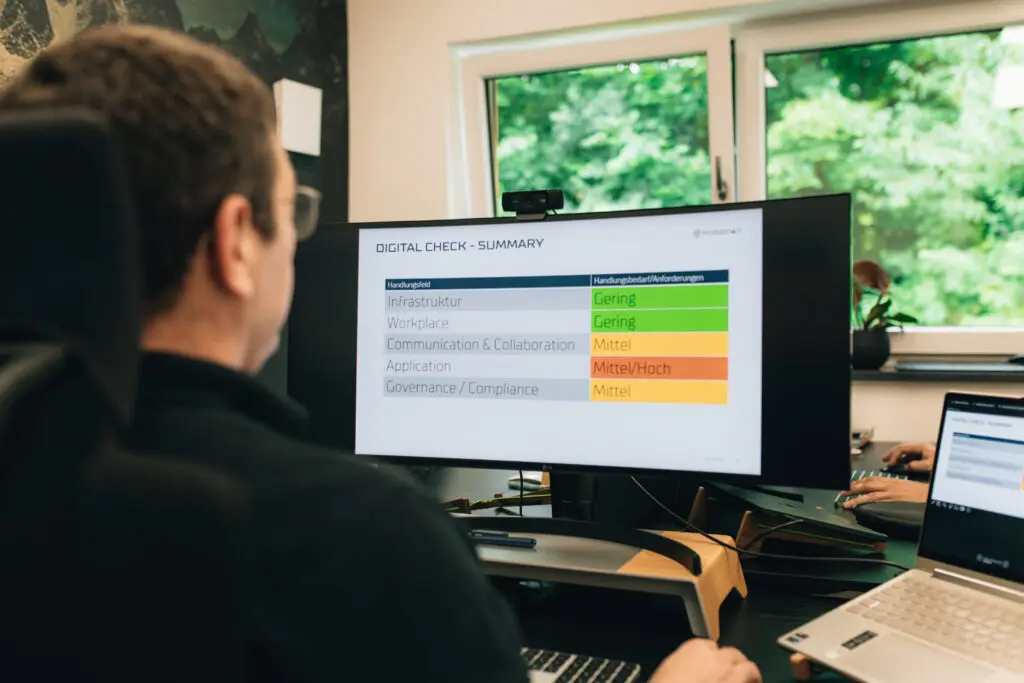
Why isn’t an online test enough? Because self-assessments are systematically biased. A professional Digital Check analyzes objectively what actually works and what doesn’t.
The PASSION4IT Digital Check uses a fixed-scope approach: 2 to 4 weeks runtime, fixed price of €3,950. At the end you receive a clear roadmap with a personalized results report and digitalization analysis.
Important: the Check is not an IT procurement project. PASSION4IT does not sell hardware, licenses, or pre-packaged software afterward. It’s eligible for BAFA funding — for SMEs up to 250 employees, up to 80 % funding in new federal states, 50 % in old ones.
The process in detail
- Organizational structure and processes — How are decisions made? What skills exist? Where is there resistance?
- IT infrastructure assessment — Which systems are in use? How well are they integrated? Where are the data silos? (76 % of SMEs have no comprehensive cybersecurity concept.)
- Identifying bottlenecks and quick wins — What can improve immediately?
- Prioritized, actionable roadmap — concrete recommendations with clear next steps.
BAFA funding
| Criterion | Detail |
|---|---|
| Subsidy rates | Old federal states: 50 %, new: 80 % |
| Max. assessment base | approx. €3,500 in consulting costs |
| Max. subsidy | up to €2,800 |
| Valid through | 31 Dec 2026 |
| Eligibility | SME max. 250 employees, max. €50M annual revenue |
The application must be submitted before the consultation starts. An SME can receive a maximum of five subsidized consultations, no more than two per year.
Best practices after the Digital Check
Phase 1: quick wins
- The “paper-stopper”: identify media breaks. Example — leave requests digital instead of manual. Effect: immediate time savings.
- The “silo-buster”: unified communication structure (e.g. Microsoft Teams). Effect: transparent information.
- The “security anchor”: close critical security gaps (e.g. MFA). Effect: protection against ransomware.
- The “shadow IT cure”: consolidate scattered software. Effect: lower license cost.
Phase 2: enablement instead of broadcast training
78 % of companies report skill gaps. Resistance must be addressed through open communication and training. PASSION4IT Academy programs build on the Check results. AI workshops build on a documented data foundation. Change management accompanies the entire transition.
Common digitalization pitfalls
Technology before organization. Example: introducing Microsoft 365 without process analysis. People keep using email instead of Teams. Solution: process analysis identifies upfront which workflows can be digitalized.
Missing prioritization. Parallel projects compete for resources. None gets finished. Solution: a prioritized roadmap defines clear sequencing based on feasibility and impact.
Underestimating change management. Employee resistance is the main obstacle. Solution: the maturity assessment captures change readiness and produces concrete actions.
Conclusion and next steps
The PASSION4IT Digital Check is investment protection. Anyone investing in digitalization or AI before knowing their maturity level risks investment ruins.
When the Digital Check makes sense:
- You’re planning larger IT investments but aren’t sure about priorities.
- Your competition is digitalizing and you don’t know where you stand.
- Past digitalization projects didn’t deliver the expected results.
- You want to use BAFA funding before the program expires at the end of 2026.
Signals your company needs the Digital Check:
- Processes are undocumented.
- IT systems don’t talk to each other.
- Decisions are based on gut feel rather than data.
- Employees work around digital tools.
Book a non-binding first conversation now — a 30-minute call clarifies whether the Digital Check is the right next step for your company.
Further resources
- PASSION4IT Digital Check — vendor-neutral assessment of your digital maturity at a fixed price, including BAFA funding options.
- Digital readiness assessment before you invest — which methods and tools exist and what they deliver.
- Digital maturity check for manufacturing Mittelstand — how industrial companies systematically assess their maturity and set priorities.