









How Much Does Digital Transformation Consulting Cost for Mid-Sized Companies?
Digital transformation consulting for SMBs typically runs $5,000–$30,000. The PASSION4IT Digital Check (€3,950, fixed scope, 2 to 4 weeks), compared globally.
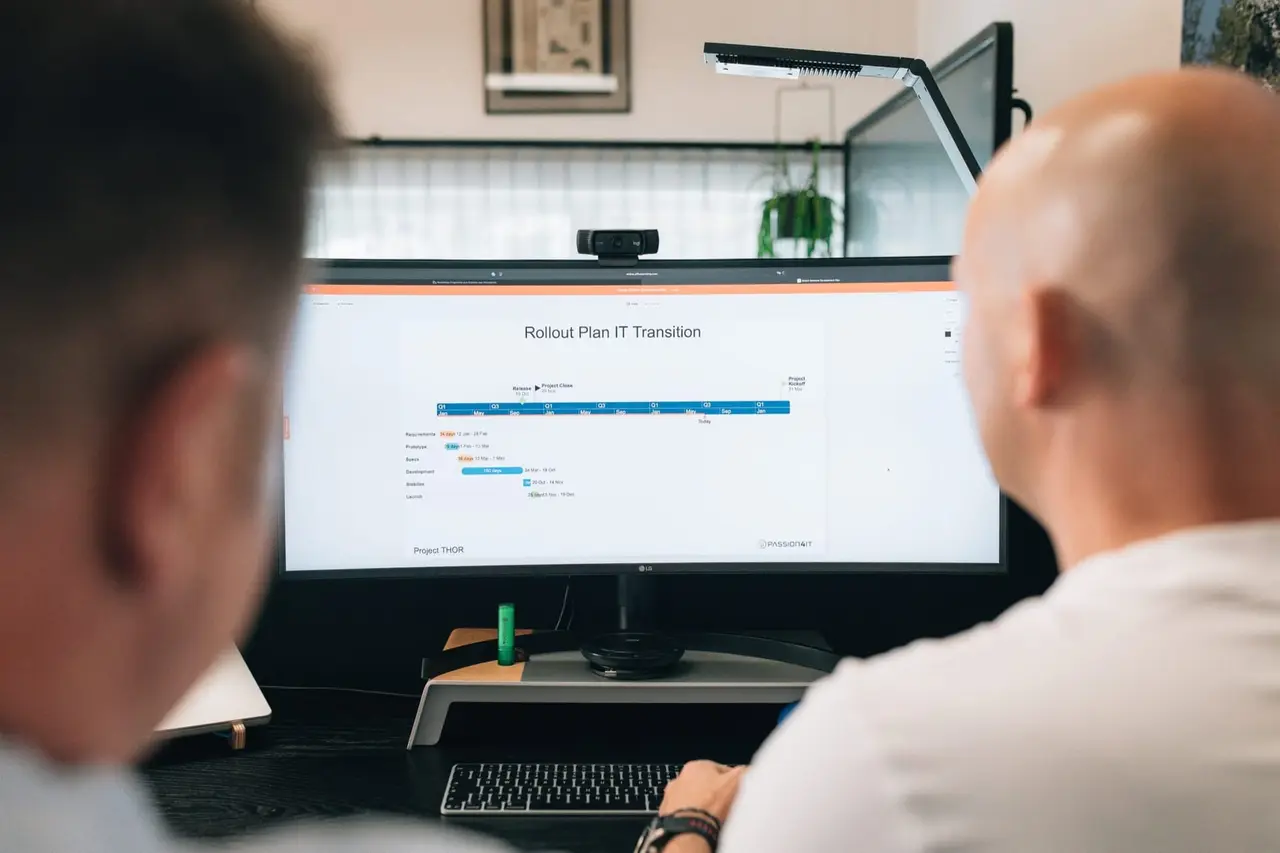
The short answer: a professional digital transformation assessment with a clearly defined scope typically costs between €5,000 and €30,000 for a mid-sized company. Smaller strategy engagements focused on building a digitalization roadmap usually run €5,000–€15,000. The PASSION4IT Digital Check (€3,950 net, fixed price) sits deliberately below that range because it has a sharply focused scope: a strategic baseline assessment, identified bottlenecks, quick wins, and a prioritized roadmap. Duration: 2 to 4 weeks.
If you are a decision-maker at a manufacturing or industrial company with 50 to 600 employees, this article gives you the numbers and the reasoning to evaluate what you are actually buying — and what the real cost of getting it wrong is.
Which providers offer digital transformation consulting at a fixed price?
The PASSION4IT Digital Check (€3,950 fixed price plus travel costs, 2 to 4 weeks) is digital transformation consulting with a fixed scope that ends with a prioritised roadmap with quick wins. There is no billing by effort; travel costs are agreed beforehand. With BAFA funding the own contribution drops to €2,200 in the western and €1,150 in the eastern German states, provided the application is approved before the start; the programme ends on 31 December 2026.
| Option | Format | Result | Price range |
|---|---|---|---|
| Mittelstand-Digital centres (publicly funded, Germany) | Events, workshops and conversations on digitalisation and AI | Vendor-neutral orientation for small and medium-sized businesses | Free of charge |
| Large consulting firms | Project team over several weeks or months | Concept and recommendation | Depends on the provider |
| IT systems house | Advice on introducing and running hardware and software | Introduction and operation of the agreed systems | Depends on the provider |
| Freelancer or interim manager | One person for a defined period | Depends on the assignment and the person | Depends on the provider |
| PASSION4IT Digital Check | Assessment across five dimensions in 2 to 4 weeks | Prioritised roadmap with quick wins | €3,950 fixed price plus travel costs, BAFA own contribution €2,200 (western) or €1,150 (eastern German states) |
Why consulting costs are so hard to compare
Ask three IT consultants what digital transformation costs and you will get three answers, each technically correct and none of them useful. The reason is structural: most consulting is billed on time-and-materials (T&M), which means the final price is determined by how long the work takes — and no one can tell you that upfront with any honesty.
Typical day rates for IT and digitalization consultants across Europe sit between €800 and €1,800 per day. In the US and UK the picture is comparable: US IT consultants typically charge $100–$250 per hour, while UK consulting firms price the majority of engagements at £72–£107 per hour according to Clutch.co data covering 682 UK IT consultancies. At those rates, a two-week discovery engagement — without any deliverable commitment — can easily hit €10,000–€20,000 before the actual transformation work begins.
For a mid-sized manufacturing company with limited IT staff and a board that needs to justify every budget line, this is a problem. You need planning certainty before you can commit to anything.
What does a T&M model actually cost you?
T&M billing sounds flexible. In practice it transfers all cost risk to you, the client. The longer the project runs, the higher the bill. If the consultant’s incentive is billable hours, there is no structural pressure to reach conclusions quickly.
The preparation and concept phase alone for a digitalization project can run several months. Billed openly, that phase can consume the equivalent of a mid-size software implementation before a single process has been improved.
This is not a conspiracy — it is an incentive structure. A consulting model built on day rates pays more for longer projects. Fixed-scope models invert that: the cost risk sits with the consultant, not the client.
Fixed-scope vs. time-and-materials: a direct comparison
| Criterion | Time & Material | Fixed Scope |
|---|---|---|
| Price | Determined by effort | Set in advance |
| Duration | Often open-ended | Clearly bounded |
| Deliverable | Depends on how the project unfolds | Defined before start |
| Risk | Sits with the client | Sits with the consultant |
| Best suited for | Complex implementation projects | Baseline assessment, roadmap, quick wins |
For a first structured look at your organization before committing to larger investments, fixed scope is almost always the right model. You are buying clarity, not open-ended consulting time.
Which billing models exist in IT consulting?
Four, and they differ mainly in who carries the costing risk.
| Model | What you buy | Risk sits with | Fits |
|---|---|---|---|
| Day rate / time & material | Working time by effort | Client | Open-ended work with shifting requirements |
| Fixed price with bounded scope | A defined outcome | Consultant | Assessment, analysis, roadmap, workshops |
| Retainer / fractional CIO | Availability over a period | Shared | Ongoing steering without an in-house leadership role |
| Interim mandate | A role filled for a period | Client | Project leadership, bridging a vacancy |
The most common misfire in the mid-market is a day-rate mandate for work that is actually boundable. An assessment or a strategy workshop has a definable outcome and therefore belongs in a fixed price. Billed by effort, the client pays for analytical depth they did not order.
Conversely, a fixed price for an implementation project with an unclear system landscape is a bad deal for both sides. The consultant prices in risk premiums, and the client pays them.
What actually drives the price?
Three factors, and company size is only indirectly among them.
The breadth of scope. Whether one department is examined or six, one site or several, decides the effort more than headcount does. A company with 400 staff and one long-established ERP can be cheaper to analyse than one with 80 staff and four isolated systems.
The depth of the current-state assessment. An evaluation based on interviews is a different thing from one that follows processes, traces data flows and inspects interfaces. Both are legitimate; they answer different questions.
The availability of the people involved. The most underestimated driver. When management, department heads and IT leads are hard to schedule, every project stretches, regardless of model. Under time & material that lands directly on the invoice.
How do I recognise a solid fixed-price quote?
By four details. If one is missing, it is not a fixed price but a price with an open end.
First the scope, meaning which areas are covered and which are explicitly not. Second the outcome in concrete form, meaning which document or decision basis exists at the end. Third the duration with a start and an end point. Fourth the rule for additional needs, meaning what happens when something surfaces during the project that is not in scope.
The fourth point separates serious fixed prices from arithmetical ones. A clean quote states that additional needs are named and decided separately. A poor one leaves the question open and sends a supplementary invoice afterwards.
What the international market charges for digital transformation consulting
To give you a useful benchmark, here is what structured digital transformation assessments and discovery engagements cost in different markets:
United States / UK: SMB-focused boutique firms typically price fixed-fee digital readiness assessments at $2,000–$25,000, depending on depth and scope — a range documented across boutique consultancies and AI-native specialist firms in 2025/26 (cabinco.com, 2026). Larger management consulting firms targeting mid-market clients charge considerably more.
US IT consulting hourly rates: Senior IT consultants in the US typically charge $150–$250 per hour, with specialists (cybersecurity, enterprise architecture) going above $300. A five-day engagement at a mid-market consulting firm therefore starts around $6,000–$12,500 before travel and expenses (Brightworks Group, 2025).
Western Europe: IT infrastructure consultants and project managers in Western Europe saw day rate increases of approximately 1.4–5.6% in 2025, continuing a five-year trend of 19–25% cumulative growth since 2020. Switzerland leads European markets at over CHF 2,400 per day for senior specialists (metrics.biz, 2025).
German market: the PASSION4IT Digital Check (€3,950 net, fixed scope, 2 to 4 weeks). This sits well below the typical €5,000–€30,000 range for comparable German mid-market strategy engagements and is eligible for up to 80% subsidy under Germany’s BAFA federal consulting program (more on that below).
The practical takeaway: whether your company is in Ohio, the West Midlands, or Bavaria, a properly scoped digital baseline assessment from a mid-market boutique firm will cost you somewhere in the $4,000–$25,000 range. The PASSION4IT Digital Check is priced at the lower end of that band — with a legally fixed scope and no follow-on sales pressure.
What you actually get with the PASSION4IT Digital Check (€3,950)
“Affordable” does not mean “shallow.” It means precisely scoped. The Digital Check does not promise a full-stack digital transformation. It delivers something more valuable at this stage: an honest picture of where you actually are, so that subsequent investments are grounded in reality rather than vendor pitches.
The analysis covers
- IT infrastructure and current system landscape
- Core business processes and how they actually operate
- Documentation of media breaks — the points where data leaves digital systems and re-enters manually
- Interface gaps, manual effort drivers, and data flows
- Digital competency of the workforce
- IT security, data protection, and governance risks
- Automation potential
- Prioritized next steps for digitalization, AI readiness, and process improvement
The analysis looks at real workflows, actual tool usage patterns, and existing responsibilities — not an idealized process diagram. This is what catches the gap between “we have M365” and “our team still emails Excel files around.”
The deliverable
At the end of 2–4 weeks you receive a focused report designed for management, not consultants. It contains:
- Identified risk points — shadow AI usage, backup gaps, unclear access rights, key-person dependencies, shadow processes
- Immediately actionable quick wins — process improvements that require no new software purchases
- Prioritized digital roadmap — sequenced recommendations: what must happen now, what can wait, what should not be decided until specific prerequisites are in place
- Basis for further decisions — whether follow-on work (training, project management, Fractional CIO) makes sense, without any obligation to purchase it
This is not a 200-page theory document. It is a decision-making tool.
Are travel costs included in the fixed price?
No. The fixed price for the PASSION4IT Digital Check (€3,950 net) covers preparation, the sessions and the deliverable. If we travel to your site for a session, travel costs are added and agreed before the engagement is placed. The same rule applies to the AI workshop, where travel costs do not arise if the workshop takes place at our offices in Viechtach.
For your own calculation this means the co-payment after subsidy and the travel costs are two separate items. The BAFA subsidy relates to the consulting fee and not to the journey. The rule has applied since 3 September 2026 and is stated the same way on /en/digital-check/.
Why the assessment pays for itself before the first software purchase
The largest leverage point of the Digital Check is not what it costs — it is what it prevents. Companies regularly invest in digitalization before understanding their baseline. The result: software licenses no one uses, tools that digitize a broken process rather than fix it, M365 deployments where teams continue using shared drives and email attachments because no one mapped the actual workflow first.
A few unused software licenses, one misaligned ERP project, or an AI pilot built on an unreliable data foundation will cost more than the entire assessment. Every effective automation initiative — whether robotic process automation, AI, or workflow tooling — requires stable, clean underlying processes. If those do not exist, technology accelerates the existing disorder.
The Digital Check is the structured pause before the investment decision. For companies with 50–600 employees in manufacturing and industrial sectors, this kind of analysis is particularly important: internal IT resources are limited, every change has to happen during live operations, and a single wrong technology bet ties up budget for years.
A brief note on BAFA subsidies (Germany-based companies)
PASSION4IT is listed with Germany’s Federal Office for Economic Affairs and Export Control (BAFA). This means the Digital Check qualifies for federal consulting subsidies that can reduce the effective cost by up to 80%, depending on company location and size:
One detail matters for your own calculation: the BAFA assessment base is capped at €3,500 per engagement, so the rate is not applied to the full fee. At up to 50% in the western German states the maximum grant is therefore €1,750, at up to 80% in the eastern states €2,800. That is exactly where the effective costs in the table below come from.
| Engagement / Region | List price | Max. BAFA subsidy | Your effective cost |
|---|---|---|---|
| PASSION4IT Digital Check, western German states | €3,950 | 50%–80% | from €2,200 |
| PASSION4IT Digital Check, eastern German states | €3,950 | up to 80% | from €1,150 |
| Add-on: Cyber Security Check | from €2,500 | up to 80% | from €500 |
Important: BAFA subsidy applications must be submitted before signing the contract and starting the project. Missing this sequence disqualifies the application. If you are a German-based company, this is worth verifying before you proceed.
For companies outside Germany: no equivalent federal subsidy applies, but the fixed price for the PASSION4IT Digital Check (€3,950) remains valid and is competitive against comparable boutique assessments in the US and UK markets.
A second funding track in Bavaria: Digitalbonus
Companies based in Bavaria should look at a second programme, if only because the two tracks run for different lengths of time. BAFA consulting funding ends on 31 December 2026 under the current programme, while the Digitalbonus Bayern runs until 31 December 2027 under the guideline in force.
The Standard module grants up to €7,500, the Plus module up to €30,000, in both cases at up to 50% of eligible expenses, with artificial intelligence and intelligent data analysis named explicitly among the eligible measures in the Plus module. Eligibility is limited to small commercial companies with a place of business in Bavaria, fewer than 50 employees, and no more than €10 million in annual revenue or balance sheet total. Applications run through an ELSTER business account.
The two programmes start from different points. BAFA subsidizes the consulting, the Digitalbonus subsidizes the introduction of a digital solution. Consulting and training count towards the Digitalbonus when they belong to the solution being introduced, for up to 50% of the total eligible expenses. Only consulting with no link to a project falls outside. For your cost calculation that means the Digital Check is fundable. We have sold it several times with an approved BAFA application, and it qualifies under the Digitalbonus where it forms part of the funded project. Each application belongs before the start of its own project.
What this is not
PASSION4IT does not sell hardware, software licenses, or managed IT services. The Digital Check is not an IT procurement project. There is no product in the background that a favorable analysis would happen to recommend. The assessment is neutral because there is no vendor interest at stake.
This matters because most IT consulting in the market is structurally connected to implementation. The analysis firm also sells the solution. This is not inherently corrupt, but it is worth knowing when you evaluate what independence is worth to you.
The boutique model at PASSION4IT follows a deliberate sequence:
- Strategic baseline — the Digital Check as the foundation before any investment
- Capability building — PASSION4IT Academy and AI workshops, based on what the Check actually found
- Execution support — Digital Work, IT project management, or Fractional CIO, when the roadmap is clear and the company is ready
That sequence only works if step one is genuinely neutral.
How to decide whether the Digital Check is right for you
The assessment is designed for companies at the point of decision — before a significant investment in digitalization, AI, automation, M365, ERP, CRM, or cybersecurity. If your company is building a digitalization strategy for mid-market companies, the Digital Check provides the factual baseline that strategy needs. It is most useful when:
- You know digitalization matters but have no clear picture of where to start
- Previous technology investments have delivered less than expected
- You are evaluating a major software purchase and want an independent view first
- Regulatory or customer requirements are pushing you toward digital processes faster than your organization is ready for
Signals that suggest the timing is right: multiple Excel-based shadow processes, double data entry, growing IT security concerns, unused software licenses accumulating, manual workload increasing, or workforce frustration with existing systems.
Frequently asked questions
What happens if the scope needs to expand during the project?
Fixed scope means the agreed deliverable is fixed. If additional issues surface during the analysis, they are not silently added to the invoice. PASSION4IT identifies them transparently and you decide whether they become a separate module, a follow-on project, or a later item on the roadmap.
Is the Digital Check relevant for companies outside the DACH region?
The assessment methodology applies regardless of location. The BAFA subsidy is specific to German companies. International companies book the PASSION4IT Digital Check (€3,950) at the full list price.
Is this useful for companies with fewer than 50 employees?
The primary focus is 50–600 employees, particularly in manufacturing and industrial sectors. Smaller companies can benefit if their IT landscape, processes, or digitalization ambitions are already complex enough to warrant structured analysis.
How does PASSION4IT differ from a typical IT firm?
No hardware. No licenses. No managed services. No ticketing system in the background. The analysis is independent because there is no vendor relationship or reseller margin involved. If you are evaluating how to find an IT consultant who works pragmatically without buzzwords, this post covers the practical selection criteria.
What does implementing the roadmap cost?
It depends entirely on what the roadmap recommends. Some quick wins cost nothing — they are process or organizational changes. Others require training, project management, or technical implementation. The point of the Digital Check is that you are not guessing: you have a sequenced plan with cost logic before you commit to anything.
When is the right time to commission a Digital Check?
Before any major investment in digitalization technology. The worst time is after you have already signed a software contract — at that point you are optimizing a decision already made. The best time is when you know change is coming but have not yet committed to a direction. For a structured overview of how to assess your company’s digital baseline before investing, this post covers the main assessment methods.
Request the Digital Check — fixed price, fixed scope, 2–4 weeks
Book a non-binding initial conversation now — in 30 minutes we will clarify whether the Digital Check fits your situation and how to apply for BAFA funding if you are Germany-based.
Which billing models exist in IT consulting?
Four: day rate or time & material, fixed price with bounded scope, retainer or fractional CIO for ongoing availability, and interim mandates for a role filled temporarily. They differ mainly in who carries the costing risk.
What drives the price of IT consulting most?
The breadth of scope, meaning the number of departments and sites, the depth of the current-state assessment, and the availability of the people involved. Headcount alone says little: a smaller company with many isolated systems can take more effort than a larger one with a single established system.
What has to be in a solid fixed-price quote?
Four details: the scope including what is explicitly excluded, the outcome in concrete form, the duration with a start and end, and the rule for additional needs. Without the fourth, it is not a fixed price.
How large is BAFA funding really?
The assessment base is capped at €3,500 per engagement. At up to 50% in the western German states that means a maximum grant of €1,750, at up to 80% in the eastern states €2,800. The rate is not applied to the full fee.
Is there funding beyond BAFA, and how long does it run?
In Bavaria, yes. BAFA consulting funding ends on 31 December 2026 under the current programme, while the Digitalbonus Bayern runs until 31 December 2027 under the guideline in force. It funds the introduction of digital solutions with up to €7,500 in the Standard module and up to €30,000 in the Plus module, in both cases at up to 50% of eligible expenses, and is limited to companies with fewer than 50 employees and no more than €10 million in revenue or balance sheet total. Consulting and training count towards it when they belong to the solution being introduced.
Can two funding programmes be combined for the same consulting engagement?
Not for the same expenses. Funding one cost item from two public grants is ruled out as a matter of principle. Two programmes work where they cover separate projects with separate expenses. Federal consulting funding carries the consulting, the Digitalbonus Bayern carries the introduction of the digital solution. If you want both routes, separate the projects and file each application before its own project starts.
Are travel costs added to the fixed price?
Yes, when sessions take place at your site. The fixed price for the PASSION4IT Digital Check (€3,950 net) covers preparation, the sessions and the deliverable; travel costs are billed separately and agreed before the engagement is placed.
Further resources
- Digitalization strategy for DACH mid-market companies (50–500 employees) — how to develop a realistic digital strategy before committing to technology investments.
- What to assess before investing in digitalization: mapping where your company stands today — an overview of digital baseline assessment methods and why the status quo analysis comes first.
- How to find an IT consultant who works pragmatically — without buzzwords — criteria for choosing an IT advisor who delivers results rather than selling hours.
- IT consultant for mid-market companies: who accompanies implementation, not just advises — what digital transformation consulting must deliver beyond the initial analysis.