








AI workshop for mid-market executives: what does it really deliver?
An AI workshop only delivers ROI when it doesn't end with a tool demo but actually tests your data, governance, and strategic readiness. Here's how a strategic workshop produces concrete results instead of slides.
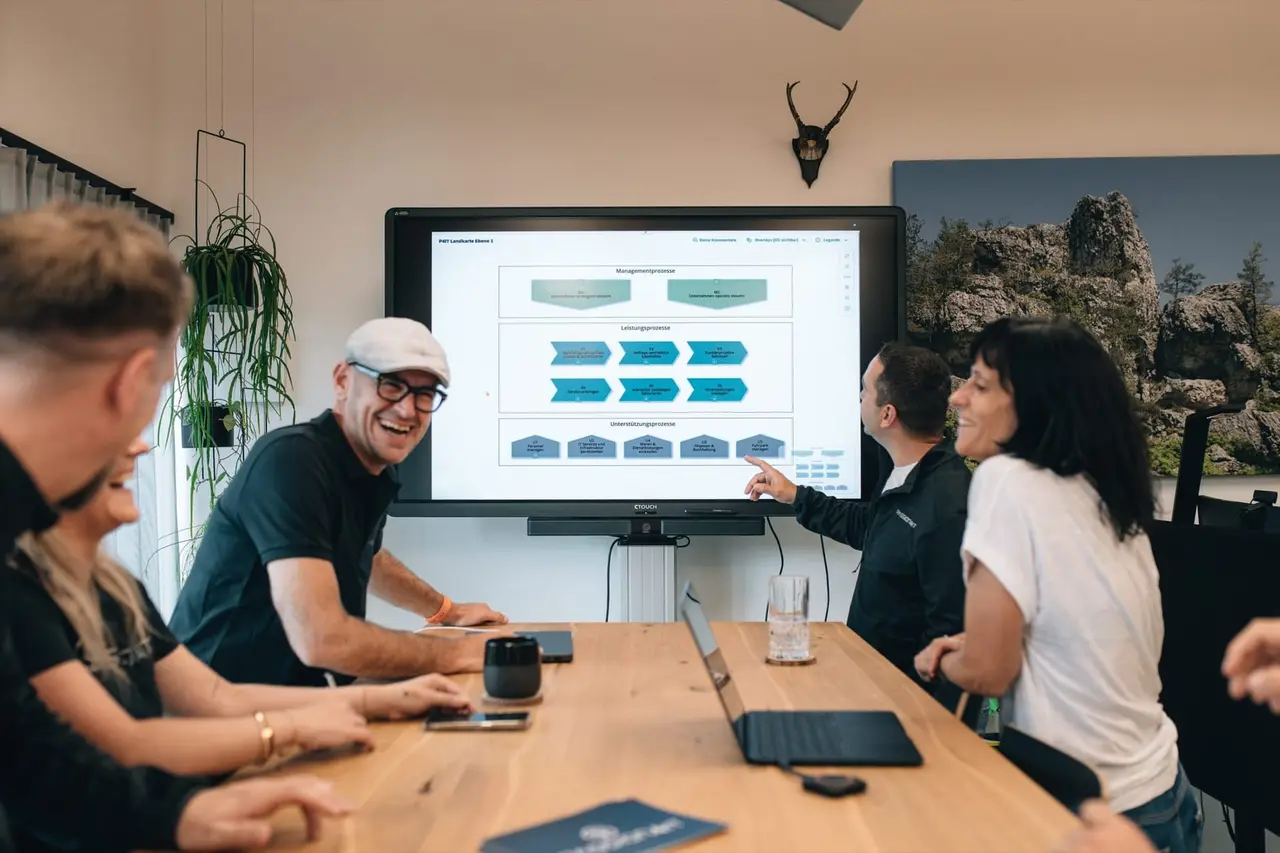
An AI workshop only pays off for you as a mid-market leader when it doesn’t end with a tool demo but actually tests your data foundation, governance, and strategic readiness. Most AI projects don’t fail on technology — they fail on missing preparation and missing strategic anchoring. The PASSION4IT AI workshop for leaders at a fixed price of €3,900 starts exactly there and ends after one day with worked-out use cases and a pilot plan for the next 30 days.
This article is for managing directors, COOs, team leads, and decision-makers in the producing mid-market with 50 to 600 employees. You’re facing the “AI yes or no” question and wondering whether a workshop actually delivers the ROI it promises. IT service providers or large corporations with their own AI departments are explicitly not the audience here.
Without a data foundation, guidelines, and strategy, any AI investment becomes a GDPR risk and a shadow-AI trap. The workshop conveys knowledge directly applicable in the daily work of mid-market leaders — to steer AI initiatives safely and effectively.
What you’ll take away:
- Why tool demos alone don’t drive transformation
- Which legal requirements the EU AI Act places on executives
- How a strategic workshop produces concrete ROI
- What sets the PASSION4IT approach apart from frontal consulting
- Which common pitfalls you should know in advance
Understanding the AI workshop landscape
The market for AI workshops is fragmented. You’ll find free webinars, half-day tool trainings, and multi-day strategy formats. The differences are fundamental: one event shows you what AI can theoretically do; the other prepares your company for practical introduction.
Tool demo vs. strategy development
A tool demo shows you ChatGPT, Copilot, or industry-specific AI applications. You see impressive possibilities, go home inspired — and then nothing happens. The reason: your company isn’t prepared.
Strategy development is different. Here you check the fundamentals first: how does your data look? Which processes are suitable for automation? Who carries responsibility for AI governance? Without an AI strategy you won’t get past the single-prototype level — sustainable success requires systematic planning.
EU AI Act compliance requirements
The EU AI Act (Regulation EU 2024/1689) has been in force since 2024. Article 4 requires providers and deployers to promote the AI literacy of their staff. Since the Digital Omnibus of 27 July 2026, there is no separate fine for this, but measures and evidence are still expected. What carries fines since 2 August 2026 is the labelling obligation for AI content under Article 50. The EU AI Act sets specific demands on transparency, documentation, and human oversight for AI applications.
Concretely, executives must understand what AI models can do and where their limits are. They must assess the context of use and judge the effect on affected people. A strategic AI workshop is the direct answer to this legal training requirement.
The shadow-AI problem
What happens if you don’t take a structured path? Your employees use AI tools anyway. They paste customer data into free ChatGPT accounts, build proposals with private Copilot logins, and experiment without guidelines. That’s shadow AI.
The risks are substantial: GDPR violations from entering personal data without a data-processing agreement. Missing data-protection impact assessments for automated decisions. In the worst case: personal liability for management when oversight duties are breached. Mid-market companies that don’t introduce AI in a structured way put their long-term viability at risk — legally and economically.
Concrete ROI of a strategic AI workshop
This is where it gets measurable. A workshop set up strategically produces concrete outcomes instead of colorful slides. AI is becoming indispensable for SMEs because it simplifies work processes and increases efficiency. The question is no longer whether, but how, you introduce AI.
Where you stand and your maturity level
Before you invest in AI, you need an honest baseline. The baseline assessment in the PASSION4IT AI workshop examines three dimensions and ends by placing each department on a four-level maturity scale:
Data foundation: Do you have structured, historical data? Are machine logs, sensor data, or customer databases available in a usable form? Without a data foundation neither predictive maintenance nor quality assurance work.
Organization and culture: Are there clear responsibilities between business, IT, and data protection? How does your team’s change readiness look? Active team involvement is decisive so AI initiatives are anchored sustainably in the company.
Technical infrastructure: Cloud or on-premises? How do IT security and interfaces look? Which internal resources are available?
Our workshop identifies quick wins with ROI in three to eight months and longer-term projects with breakeven after six to eighteen months.
Developing binding AI guidelines
AI governance covers defining guardrails for AI use, in order to manage risks systematically and meet compliance requirements. Guidelines aren’t a paper tiger — they’re your protection against shadow AI and GDPR violations.
A workshop produces legally robust usage policies: which tools may employees use? Which data may go into prompts? Who approves new AI applications? How are AI-generated outputs labelled?
This includes GDPR-compliant safeguards: data-processing agreements with tool providers, data-protection impact assessments for high-risk applications such as automated HR decisions, clear documentation of use cases. An effective governance model contains clear responsibilities, risk management, and criteria for selecting use cases.
Building a strategic roadmap
The roadmap prioritizes AI use cases by effort-vs.-benefit. It identifies use cases for productivity gains and creates the basis for a sustainable, data-driven business strategy.
Prioritization criteria: What is the use case’s impact on revenue and cost? How does the data situation look? Which legal, organizational, and technical risks exist?
Budget and resource planning: Costs for data preparation, pilot projects, tool licenses, governance, and training for the next twelve to eighteen months.
Change management: Executives should learn how to align AI initiatives with company goals and demonstrate value with KPIs and ROI logic. A prioritized use-case portfolio and business-case criteria are essential to compute ROI realistically.
The PASSION4IT AI workshop in practice
The PASSION4IT approach follows the principle: strategy before implementation. No AI investment without a sound basis for decision.
1. The AI readiness check (the 2-minute start)
Before we go into the workshop together, you set a first baseline online in just two minutes. This free AI readiness check analyses your processes, data, and tool landscape. The result is an honest indication where AI can already help today and where gaps still exist in documentation or organization.
2. The one-day workshop (the deep dive)
The PASSION4IT AI strategy workshop is an intensive one-day format (6 hours), offered as a fixed-price model at €3,900. To get the best results, the strategic minds belong at the table: managing director, COO, and the relevant team and department leads (e.g. from production, logistics, or sales).
This is where we get into the substance. A short kick-off call sets the goals beforehand, and the day itself has five blocks:
- Where you stand, with your IT landscape and the maturity level per department
- Understanding AI without the hype, from machine learning to AI agents, including risks such as hallucination and bias
- A hands-on session with three worksheets, in which you work a real bottleneck from the friction point card via the use case card to the AI pilot canvas
- Rules and the EU AI Act, covering your role as a deployer, which data may go into which tool, and clear approvals for new tools
- Tools and the 30-day plan, with a vendor-independent tool overview and the week-by-week plan for the first pilot
Methodology of choice: We work beyond PowerPoint. Optionally we use LEGO® Serious Play® to make strategy and change processes tangible — ideal for engaging the leadership team emotionally and technically.
3. The outcomes (your basis for decisions)
You leave the workshop not with vague ideas but with concrete deliverables:
- The maturity level per department
- Worked-out use cases on three worksheets
- A planned 30-day pilot with success criteria and a named owner
- A prioritized AI roadmap with realistic steps
- Clarity about the necessary data foundation
- A foundation for the next logical steps: enabling your team in the PASSION4IT Academy or introducing tools such as the AI buddy amaiko.ai
The approach is vendor-neutral. Whether amaiko, Copilot, or custom solutions are deployed later is decided after the strategy phase. The workshop prepares the basis — independent of which tools follow.
Investment vs. funding
PASSION4IT is registered as an authorized consulting firm (BAFA consultant number 222542), which makes this workshop publicly fundable. Most important rule: The funding application must be submitted and approved before the consulting starts and before any contract is signed. The BAFA consistently rejects retroactive applications.
| Item | West (50 %) | East (80 %) |
|---|---|---|
| Workshop fixed price | €3,900 | €3,900 |
| Max. eligible amount | €3,500 net | €3,500 net |
| Government grant | €1,750 | €2,800 |
| Effective net cost | €2,150 | €1,100 |
Note: BAFA funding covers only the conceptual strategy consulting. Operational software introduction or later tool licenses are excluded.
Distinction from tool training
The consulting logic follows a clear sequence:
- AI strategy development (the workshop — foundation)
- AI enablement (Academy / AI driving license — for the workforce)
- AI implementation (concrete tools — only at the very end)
Why does a Copilot rollout without guidelines fail? Because employees either ignore the tool or use it wrongly. Because data flows into systems that aren’t checked. Because no one knows which tasks should be prioritized. AI isn’t an IT project — it’s a management task.
Common problems — and realistic solutions
Even the best workshop can’t remove every obstacle. Here are the typical challenges and how to handle them.
Inflated expectations of AI
Many companies expect revenue growth before they see cost savings or positive cash flow. That’s rare in year one. Moonshot projects with high investment have significantly lower success rates than smaller projects with clear use cases.
Solution: Identify quick wins. Example: partial automation of document processing for recurring routine tasks, or automated FAQ in service. Generative AI accelerates administrative coordination, freeing executive time for strategic work.
Resistance in middle management
Middle management often sees danger: loss of jobs, extra workload, loss of control. Without buy-in at this level, every AI initiative fizzles.
Solution: Position AI as support, not replacement. Involve the affected teams in use-case selection. Communicate transparently about goals, timeline, and success criteria.
Insufficient data foundation
Without structured, historical data, predictive maintenance, reliable demand forecasting, and automated quality control don’t work.
Solution: Step-by-step data structuring as preparation. The workshop reveals gaps and defines which data needs to be cleaned first.
Conclusion: why the AI workshop is your safety net
AI in the mid-market isn’t an IT experiment. Anyone who starts without preparation risks violating the EU AI Act labelling obligation and burns valuable capital on projects that never leave the pilot phase.
A strategic AI workshop at PASSION4IT answers “what does it really deliver?” with measurable results instead of vague promises. We’re not theorists — we’re practitioners who understand the producing mid-market.
Why PASSION4IT is the right partner:
- Award-winning innovation: As a TOP 100 Innovator and recipient of the High Performance Award we’re among the leading minds for digital transformation in the mid-market.
- Experience that counts: We bring insights from more than 100 successful customer projects across DACH directly into your workshop.
- Focus on the mid-market: We don’t consult IT service providers or large corporations. Our concepts are tailored to companies with 50 to 600 employees. Pragmatic, executable, no buzzwords.
Next steps
- Check BAFA eligibility (eligible base up to €3,500 net)
- Run the AI readiness check and schedule a first conversation
- Internal preparation: identify stakeholders, review the data situation
- Run the workshop and adopt the roadmap
- Plan AI enablement and implementation as follow-on steps
Use our free 2-minute AI readiness check to get an immediate first read on your potential. In a non-binding first conversation we’ll then plan your individual strategy workshop, including BAFA funding.
Book a non-binding first conversation now — free of charge, 30 minutes, no obligation.
Further resources
- AI strategy & readiness for the mid-market — Overview of AI readiness, strategy, and implementation support for companies with 50 to 600 employees.
- From strategy day to a concrete implementation plan — What a one-day workshop concretely delivers: roadmap, prioritization, business cases.
- How do I measure whether AI really benefits my company? — ROI measurement and KPIs for AI projects in the producing mid-market.
- Introducing AI without disrupting operations — Step-by-step guide to AI adoption without operational disruption.
Frequently asked questions
Why not just buy ChatGPT Plus for everyone? Without guidelines, company data ends up in uncontrolled systems. Shadow AI grows, GDPR risk grows. Tools without strategy don’t solve problems — they create new ones.
Do we already need an AI department for the workshop? No. The workshop sets the basis and examines whether and how you should build AI competence. It’s the start, not a prerequisite.
Is the workshop tied to specific software? No, 100 % vendor-neutral. Strategy development is independent of which tools are implemented later.
How is this different from free AI webinars? Webinars inform; workshops transform. You don’t get a PowerPoint show — you get a roadmap, guidelines, and an investment plan specific to your company.