







A learning platform I don't have to build myself — ready-made with content for the DACH mid-market
Ready-made learning platforms with preconfigured content make digital training the core of successful employee adoption — without your own LMS, without content production. The PASSION4IT Academy delivers exactly this approach for the DACH mid-market.
Digitization in the mid-market doesn’t fail because of missing technology — it fails because people don’t understand the technology, don’t want to use it, or don’t know how to use it safely. That’s exactly why, as a mid-market company, you need a learning platform that works immediately: without months of build time, without your own content production, without IT complexity.
The problem: the numbers prove the digital pressure. Most companies in the DACH region already rely on digital learning. But while the e-learning market grows rapidly, an enormous gap opens up in practice: the gap between acquiring expensive software and the actual, safe use by the workforce. The decisive question for your business is therefore not whether you train your employees — but whether the training you offer today still lands in daily work tomorrow.
The direct answer: ready-made learning platforms with preconfigured content make digital training the core of successful employee adoption — without you having to develop courses yourself, set up an LMS, or assign a project team. The PASSION4IT Academy delivers exactly this approach: practice-oriented learning stones of 15–20 minutes that are immediately applicable in daily work.
This article is aimed at management, HR managers, and IT leads in SMEs and mid-market companies who are looking for a ready-made e-learning platform for the DACH market. You’ll learn:
- What ready-made learning platforms with content concretely are and which types exist
- Which special requirements the DACH mid-market places on training
- How DACH-specialized solutions differ from US platforms like LinkedIn Learning
- Which concrete steps lead to implementation — without a major project
- How to avoid typical pitfalls during introduction
What are ready-made e-learning platforms with content
A ready-made learning platform with content is a fully configured training system that not only provides the technical infrastructure — user management, reporting functions, certification — but also contains a catalog of pre-built course content that can be used immediately without your own development. Modern learning platforms enable efficient learning without your own content creation.
The decisive difference: with an empty LMS system (enterprise LMS) you first have to develop or buy content, build course structures, define learning paths, and produce video courses. In contrast to other platform models or approaches, the focus here is therefore not on later filling, but on immediate usability. With individual course development you invest months in a project that ties up internal staff and devours budget. Ready-made learning platforms eliminate both hurdles — you register your employees and learning starts immediately. Learning platforms offer instantly accessible course libraries that enable a start without lead time.
Three types of ready-made learning platforms
Industry-specific platforms deliver ready-made content for specific industries. Examples are platforms for logistics with mandatory training such as fire safety or forklift instruction, or providers like Haufe Akademie that provide ready-made learning modules on occupational safety and compliance. They are ideal when your company has industry-specific instruction obligations.
Topic-specific academies focus on certain competence areas such as AI, cyber security, or Digital Work. The PASSION4IT Academy is an example of this approach: four clearly defined modules — AI license, Cyber Security, Digital Work with M365 and Teams, and Building Leaders — address exactly the competence gaps that have the biggest lever in the mid-market, and can be shaped by content from experts in relevant fields.
Universal platforms like LinkedIn Learning or Udemy for Business offer a broad variety of general knowledge with extensive course libraries of over 21,000 modules. For the specific need of the DACH mid-market, however, these globally oriented offerings hit structural limits in practice: the content is often standardized, partly purely English-language or automatically translated. Moreover, they often don’t fully map the specific legal frameworks and compliance requirements of the German-speaking region.
An American video course full of IT jargon is of no use to the assembly-line worker or the accountant. They need pinpoint, German-language practical bites that are understood immediately without prior knowledge.
Core components and learning offerings of ready-made learning platforms
Preconfigured learning modules with optimal learning duration: Microlearning modules achieve completion rates of up to 83%. The PASSION4IT Academy relies on learning stones of 15–20 minutes — short enough for daily work, long enough for real knowledge transfer. Michael Fischer, ABF Synergie GmbH, confirms: “In 15–20 minutes, I always take away something concrete.”
Certification system for provable competence: not attendance confirmations, but certificates per completed training that document that an employee has actually built competence. Statutory compliance trainings are an important offering that is legally secured through certificates.
GDPR-compliant infrastructure: a clear majority of companies see GDPR compliance as the most important purchasing criterion when selecting an e-learning platform. A ready-made platform must take this compliance effort off your hands, not cause it.
Why the DACH mid-market brings entirely its own requirements is shown in the next section.
Special requirements of the DACH mid-market
The DACH mid-market differs fundamentally from large corporations and international markets. Most companies in Germany are SMEs, and SMEs provide a large share of the jobs in Germany. These companies have different budgets, different structures, and different expectations of training than a DAX corporation with its own corporate university.
Legal and cultural specifics
GDPR compliance is, in the DACH region, not a nice-to-have function, but a minimum requirement. GDPR-compliant platforms have a structural advantage over US providers, which are under increasing GDPR pressure and require caution. Hosting on German or EU servers, data isolation, encryption, and documented data deletion are mandatory — not optional.
German-language content without IT jargon is decisive for acceptance among non-IT staff. If you want to make your entire workforce reachable — from the warehouse worker to the head of sales — learning offerings must be formulated in understandable language, with practical examples from the German workday.
Particularly acute: since 2 February 2025, Article 4 of the EU AI Act has been in force. It obliges every organization in the DACH region — regardless of whether GmbH, GmbH & Co. KG, or AG — to prove documented AI competence (AI literacy) of the affected employees when deploying AI systems.
From August 2026, the regulator tightens the thumbscrews: AI in education is classified as high-risk, and hard sanction and fine mechanisms take effect. Those who today allow AI tools in the company without broadly qualifying the workforce are, as managing director, fully liable for GDPR violations and uncontrolled shadow AI.
Organizational realities
Most mid-market companies don’t have their own HR or IT department that could build a learning platform, produce content, and shoulder a rollout project. The smallest companies make up a large share of SMEs in Germany — here there is neither budget nor staff for weeks-long implementations.
The time budget for further education is limited: 15–20 minutes per learning unit instead of full-day seminars is the reality. Full-day workshops lead to high absence, low transfer, and frustration on all sides. Almost half of learning activity already takes place on mobile devices — learning must work on every device, device-independent and at one’s own pace.
The budget range typically moves between 39 and 99 EUR per user per year. The PASSION4IT Academy, with the AI license at 59 EUR, Cyber Security at 39 EUR, Digital Work at 39 EUR, and the Business Bundle at 99 EUR per user per year, lies exactly in this range.
Subject-matter challenges
Employees in SMEs have strongly heterogeneous prior knowledge of digital topics. Some already use AI tools daily, others struggle with basic Microsoft 365 functions. Adaptive learning can be applied to such heterogeneous learning groups — demand for adaptive learning has risen significantly in recent years — the growing use of AI changed training requirements in the mid-market.
Practical applicability in daily work is decisive for acceptance. Almost all respondents rate their e-learning ROI as positive — but only when the content is immediately actionable and directly takes up new digital technologies in daily work. Course content without a concrete connection to daily work is simply not used.
What concrete solution approaches for these requirements look like is shown in the following comparison.
Concrete solution approaches and provider comparison
The market offers various approaches for ready-made e-learning courses — from US platforms with a global course catalog to specialized DACH solutions. There are specialized learning platforms for the DACH mid-market, and the choice depends on which problem you primarily want to solve.
The PASSION4IT Academy as a benchmark solution
The PASSION4IT Academy is not a classic e-learning platform and not a seminar program. It is a practical enablement layer that delivers digital competence in learning stones that are immediately applicable in daily work. In doing so, the Academy translates current trends in further education for the mid-market into concrete, directly usable learning offerings.
Four specialized modules:
- AI license (59 EUR per user/year): EU AI Act Art. 4 compliant qualification — opportunities, risks, legal frameworks in handling AI, differentiated role-specifically and efficiently developed further with AI support
- Cyber Security (39 EUR per user/year): IT security for non-IT staff, from phishing detection to safe handling of data. The PASSION4IT Academy integrates security knowledge directly into the work context
- Digital Work (39 EUR per user/year): productive collaboration with M365 and Teams — not as a software manual, but as workflow orientation
- Building Leaders: modern leadership in digital work environments
- Business Bundle (99 EUR per user/year): all modules combined for sustainable transformation
What distinguishes the Academy from classic e-learning:
- Learning stones of 15–20 minutes instead of a seminar day or frontal training
- Certificate per completed training — provable competence, not just attendance
- Designed for non-IT staff: no jargon, no prerequisites, entire workforce reachable
- Device-independent, at one’s own pace, scalable without classroom overhead
- GDPR-native infrastructure without US data transfer
The PASSION4IT Academy solves the most underestimated problem of modern personnel development: the acceptance crisis. What happens when a company introduces AI tools without bringing employees along with the AI license? Dangerous shadow AI arises. Employees use ChatGPT & co. secretly in the background — without any awareness of data security, bias, or copyright. It is exactly this existential liability risk that we eliminate.
Comparison of different platform types
| Criterion | DACH-specialized (e.g. PASSION4IT Academy) | US platforms (e.g. LinkedIn Learning) | Industry-general (e.g. Haufe Akademie) |
|---|---|---|---|
| GDPR compliance | Native, EU servers | Limited, US data transfer | Mostly compliant |
| German-language content | Yes, for non-IT staff | Partly, often translated | Yes, but broad focus |
| Mid-market focus | Core target group | Rather enterprise/individual users | Mixed |
| Cost per user/year | 39–99 EUR | ~240 USD (~220 EUR) | Variable, often higher |
| Implementation time | Immediate | Immediate, but without course structure | Days to weeks |
| Compliance proofs | Certificate per course | Attendance confirmation | Varies |
LinkedIn Learning offers enormous breadth with over 21,000 courses — but no course structure tailored to the DACH mid-market, no EU AI Act-compliant AI training, and no learning stones optimized for 15–20 minutes of practical transfer. When is LinkedIn Learning an alternative? When you’re looking for broad inspiration for individuals. When not? When you need measurable workforce qualification with compliance proof.
Hybrid providers enable the integration of external course libraries — that can be sensible when you want to combine industry-specific content with thematic modules.
Implementation process in 4 steps
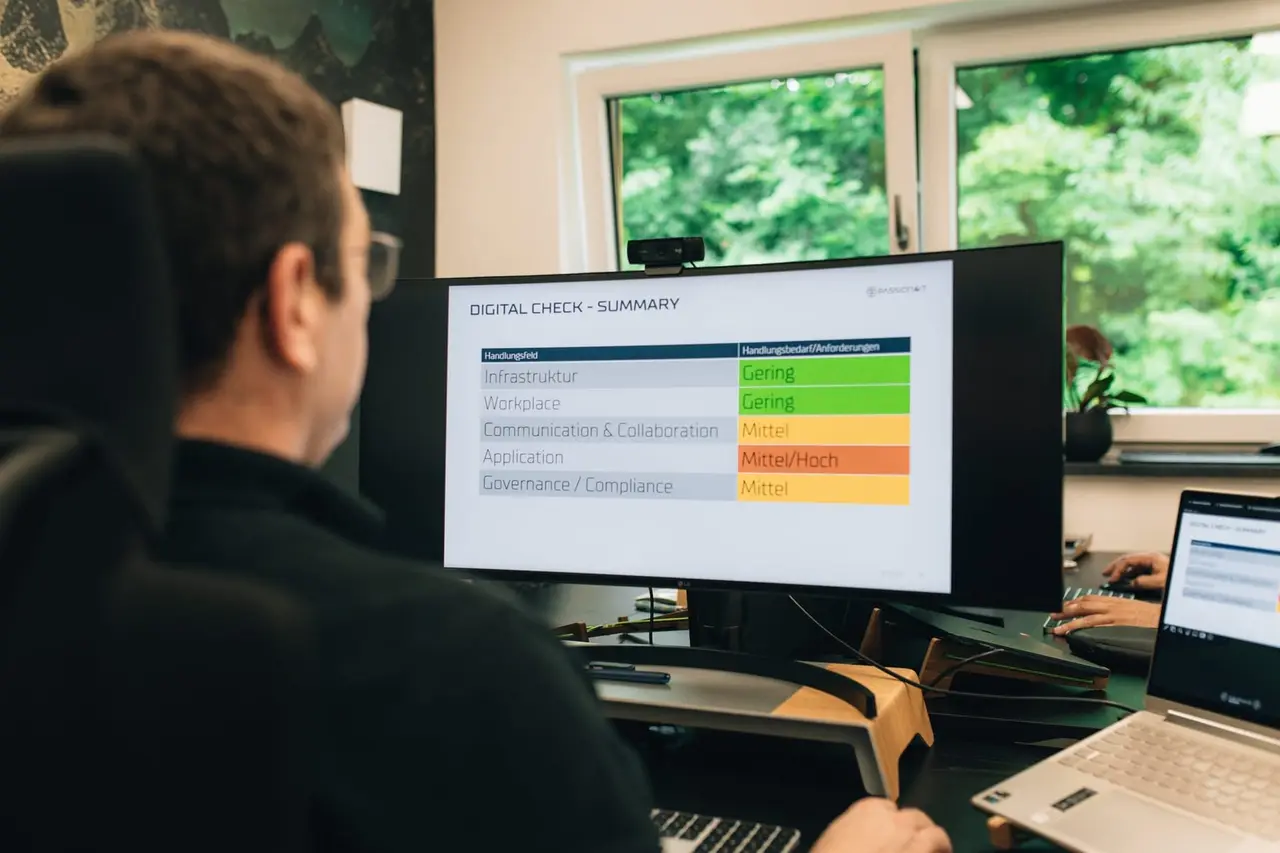
- Needs analysis and module selection: which competence areas have priority? A Digital Check or AI Readiness Check helps with orientation — AI license, Cyber Security, Digital Work, or all three in the Business Bundle, as the first structured step of implementation.
- User registration and access management: employees register via email address, receive access to the platform, and can start on any device — without an IT project, without software installation.
- Pilot group with 10–20% of the workforce: start with a pilot group, gather feedback, measure completion rates, and identify optimization needs before you scale; where available, this feedback can also flow in from exchange with internal or external partners.
- Full rollout with success measurement: scale to the entire workforce, use reporting functions for analysis and documentation — especially relevant for EU AI Act proofs.
Common challenges and proven solutions
Even the best ready-made learning platform fails when typical pitfalls are not addressed. Here are the three most common problems and proven recommendations for action.
Problem: low usage rate despite an available platform
The platform is up, the courses are there — but no one uses them. That happens when further education is positioned as a leisure activity instead of as part of work.
Solution: integration into working time, instead of positioning further education as an add-on after the workday. Executives must lead by example here: those who have completed the AI license themselves can authentically communicate in the team why the knowledge makes the difference in daily work. To do justice to the heterogeneity in the mid-market, modern e-learning concepts increasingly rely on AI-supported, adaptive learning. The systems analyze learning data in real time and adapt the paths individually to the participant’s level. That doubles learning efficiency. The trend in the market is clear: experts expect full AI standardization in digital education by 2027. Those who rely on modern platforms here pick up every employee exactly at their prior knowledge.
Problem: content doesn’t match the company reality
Generic courses about “digitization in general” produce no practical transfer. When your sales team doesn’t understand how it can use AI in a customer conversation, the course remains a mandatory exercise.
Solution: choose practice-oriented modules that are immediately applicable. The PASSION4IT Academy delivers learning stones tailored to concrete use cases in daily work — not to theoretical knowledge. Decisive here is also a complete picture of the application context for the employees. Which AI tools make sense for the manufacturing mid-market is explained in the modules using real scenarios. Many solutions are specifically tailored to the needs of small and medium-sized enterprises — when choosing, pay attention to whether the provider understands the mid-market.
Problem: compliance uncertainty with US platforms
US platforms are under GDPR pressure. Storing your employees’ data on US servers can become a compliance risk — especially when the works council has a say or auditors ask questions.
Solution: prefer DACH-based providers with EU server infrastructure for GDPR compliance, because that is the most heavily weighted purchasing criterion in the DACH market — and for good reason. Compliance and data protection are industry-standard topics on learning platforms, and those who rely on a GDPR-native solution from the start save themselves later migration and legal risks. Learning platforms thereby enable time- and location-independent further education without data having to leave the European area. A detailed market overview helps with selecting an LMS for companies — the websites of analysts and industry associations provide insight and information here.
Conclusion: act instead of waiting — digitization at eye level
The question in the modern mid-market is long no longer whether your employees need digital training. The question is how long you can still afford the loss of control through uncontrolled shadow AI and unused Microsoft licenses before, in August 2026, the hard regulatory thumbscrews of the EU AI Act take inexorable effect.
Ready-made learning platforms with proven content solve this implementation problem between the digitization decision and employee adoption — without a major project, without your own content production, and without IT complexity.
The PASSION4IT Academy closes exactly this gap. We don’t deliver theoretical full-day seminars that fizzle out in daily stress. Instead, we rely on focused, 15- to 20-minute learning stones for the DACH mid-market: in German, GDPR-compliant, and at prices that fit every SME budget.
Now to your turnkey learning platform
An end to legal risks, unused software licenses, and the time-consuming search for suitable content. Bring your team to a uniform, legally secure level — pragmatic and without internal IT effort.
Secure your no-obligation initial consultation now. In just 15 minutes we analyze your current situation and show you the direct path to your Academy.
Book a non-binding first conversation now — directly to the needs analysis and appointment booking.
Further resources
- PASSION4IT Academy — training, e-learning, and enablement for the mid-market — practice-oriented learning stones for AI, cyber security, digital work, and leadership.
- AI license under EU AI Act Art. 4: mandatory training for mid-market employees — what the documentation obligation means and how to fulfill it in a legally secure way.
- E-learning platform for the mid-market: really applying Microsoft 365 — how M365 training measurably improves daily use.
- Training 50 employees in AI — without classroom overhead and without high costs — scalable approach for broad-based AI qualification.
- Cyber security training for the mid-market: employees certified and secured online — from phishing detection to compliance proof.
Frequently asked questions
What does a ready-made learning platform cost for 100 employees per year?
That depends on the provider and module scope. With the PASSION4IT Academy, the costs lie between 3,900 EUR (a single module like Cyber Security at 39 EUR per user) and 9,900 EUR (Business Bundle at 99 EUR per user) for 100 employees per year.
How quickly can employees start learning after registration?
With ready-made learning platforms like the PASSION4IT Academy, immediately. Registration is via email address, access is device-independent, and the first learning stone can be completed within minutes of booking — no onboarding project, no IT installation.
Are the certificates legally usable for compliance proof?
Yes. Certificates per completed training document provable competence and are relevant for the documentation obligations under EU AI Act Art. 4. They prove who was trained on what and when — important for audits and works council inquiries.
How does a ready-made learning platform differ from LinkedIn Learning?
LinkedIn Learning offers breadth (over 21,000 courses) and is suitable for individual further education. Ready-made DACH platforms like the PASSION4IT Academy offer depth: course content aligned with German legislation, mid-market focus, EU AI Act-compliant course modules, learning stones of 15–20 minutes instead of 45-minute video courses, and GDPR-native infrastructure.
What GDPR guarantees are there with DACH-based providers?
DACH-based providers host on EU servers with full data isolation and offer documented data deletion, role and permission management, and encrypted data transmission. A clear majority of companies rate GDPR compliance as the most important purchasing criterion — DACH providers meet this requirement natively.
Can a ready-made learning platform be connected to existing IT systems?
Many ready-made platforms offer interfaces to HR systems, single sign-on, and social media integration. The integration effort varies depending on the provider and existing infrastructure. The PASSION4IT Academy is deliberately designed to work without deep IT integration — access via email address is enough.
What happens upon cancellation — do certificates remain?
Earned certificates belong to the employees and remain after completion of the respective training. Clarify the exact conditions with the provider before booking — with reputable partners, that’s the standard.