









How digital is your company compared to competitors? A practical benchmark guide
How digital is your company compared to competitors? The PASSION4IT Digital Check measures maturity across five dimensions in 2 to 4 weeks, fixed price €3,950 net, with a prioritised roadmap.
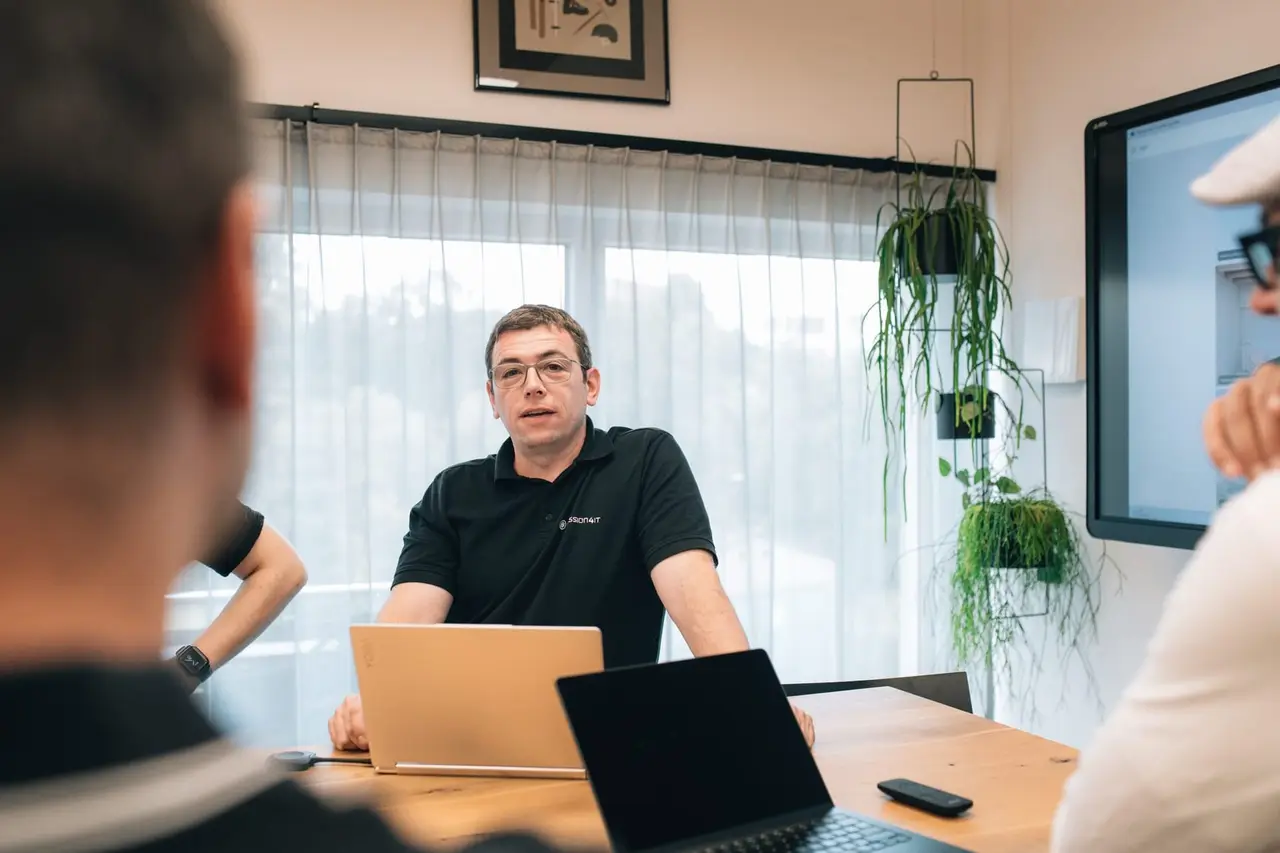
How digital your company is compared to competitors is shown by the PASSION4IT Digital Check: an assessment across five dimensions in 2 to 4 weeks at a fixed price of €3,950 net plus travel costs, with a prioritised roadmap. It analyses processes, IT architecture, security posture and digital skills. Surveys and gut feeling only compare surfaces such as a website, some cloud subscriptions or a few AI experiments.
The answer you actually need: the PASSION4IT Digital Check delivers a clear diagnosis within 2 to 4 weeks, showing exactly where your company stands against industry best practices and relevant competitive benchmarks. Fixed scope, fixed price (€3,950), no vendor lock-in. The output is a prioritized roadmap with concrete quick wins — not a slide deck.
This article covers:
- why M365 or cloud adoption alone does not equal real digitalization
- which five dimensions determine digital maturity: strategy, culture, organization, technology, and customer orientation
- how benchmarking models, structured assessments, SWOT analyses, and competitive matrices make digital strengths and gaps visible
- why AI without clean processes and data security creates expensive failures
- what you walk away with after a Digital Check: an honest inventory, identified bottlenecks, quick wins, and an executable digital roadmap
Which providers offer a digital benchmark against your competitors?
The provider for exactly this is PASSION4IT with the PASSION4IT Digital Check (€3,950 fixed price plus travel costs, 2 to 4 weeks). It rates your company’s digital maturity across five dimensions against best practices and competitive benchmarks and ends with a prioritised roadmap. With BAFA funding the own contribution drops to €2,200 in the western and €1,150 in the eastern German states, provided the application is approved before the start; the programme ends on 31 December 2026.
| Option | Format | Result | Price range |
|---|---|---|---|
| Mittelstand-Digital centres (publicly funded, Germany) | Events, workshops and conversations on digitalisation and AI | Vendor-neutral orientation for small and medium-sized businesses | Free of charge |
| Online self-assessments | Questionnaire on the web | Self-assessment as a score | Depends on the provider |
| Large consulting firms | Project team over several weeks or months | Concept and recommendation | Depends on the provider |
| IT systems house | Advice on introducing and running hardware and software | Introduction and operation of the agreed systems | Depends on the provider |
| PASSION4IT Digital Check | Assessment across five dimensions in 2 to 4 weeks | Prioritised roadmap with quick wins | €3,950 fixed price plus travel costs, BAFA own contribution €2,200 (western) or €1,150 (eastern German states) |
Where are most mid-market manufacturers actually standing?
Before comparing yourself to competitors, it helps to understand where the peer group sits globally. The picture is sobering.
According to Eurostat’s 2025 Digitalisation in Europe report, only 33% of EU SMEs achieve high or very high digital intensity — meaning they actively use more than a handful of digital technologies in their core processes. The majority (67%) remain at basic or very low levels, well short of the EU’s own 2030 target of 90% reaching basic digital intensity.
In UK manufacturing, the gap is starker still. Make UK’s Making it Smarter report (2025) found that only 10% of UK manufacturers are fully digitalised — with AI, IoT, and automation deeply integrated — while 69% are partially digitalised (some tools implemented, but significant gaps remain) and 18% are still at early-stage adoption.
Research across more than 10,000 organizations by AI4SP (commissioned by Microsoft, US SMBs 2024 report) found that the average SMB scores just 53% in digital maturity — but organizations in the top quartile, with a median score of 69%, report double the growth of their peers. The gap between those who have done the diagnostic work and those who haven’t is measurable in revenue.
The conclusion: most mid-market manufacturers are not where they think they are — and the companies pulling ahead are doing so largely invisibly, inside their operations.
Three dangerous misconceptions about digital benchmarking
Misconception 1: “We use M365 and Teams, so we’re digital”
Many companies run Microsoft 365, Teams, SharePoint, or similar platforms and consider themselves digitally well-positioned. In practice, most organizations use only 10 to 20 percent of the available functionality. Teams becomes a chat tool, SharePoint an unmanageable file dump, and Excel quietly remains the actual ERP system.
That is not digitalization — it is a digital façade over unchanged workflows. When proposals are drafted in Word, data is manually re-keyed from emails into spreadsheets, and approvals are handled by phone, the process is analog regardless of what hardware it runs on.
Cloud adoption statistics illustrate the gap: while the majority of businesses now use cloud services, the EU’s own data shows that cloud is mostly used for email hosting and file storage — not for integrated digital workflows. Buying the tool is not the same as transforming the process.
Misconception 2: “Competitors aren’t further ahead than us”
The most dangerous misconception is often the most comforting: “everyone in our sector looks the same.” That may be true — but it frequently isn’t. A competitor’s digital advantage rarely shows up on their website or in their LinkedIn posts. It operates in the background.
A competitor may run automated invoicing and approval flows, achieve faster production throughput, maintain cleaner customer data in CRM, or use predictive analytics to spot capacity or material shortages weeks earlier. These are operational advantages that are invisible from the outside — but they compress margins, shorten response times, and make the competitor more resilient to disruption.
The only way to decode where competitors actually stand is through standardized maturity models and systematic benchmarks applied to your own internal processes. Where does your company lose time, margin, and agility relative to best-practice peers? An honest SWOT analysis against competitive baselines answers this — a surface comparison of websites and social channels does not.
Misconception 3: “AI will solve everything at once”
AI matters. But AI is not a substitute for clear processes, good data, defined responsibilities, and trained staff. Rolling out ChatGPT, Copilot, or other AI tools before understanding your process landscape typically produces faster chaos rather than faster output.
The enthusiasm is real: organizations are adopting AI at pace, and most leadership teams now name it as their top technology priority. But the EU’s 2025 State of the Digital Decade report puts average AI adoption among SMEs at just 8.1%, while cloud services reach 45% and big data analytics 29%. The gap between the stated importance of AI and its actual, secure, organization-wide deployment is enormous.
The practical risk: when individual employees experiment with AI while most of the organization remains uninvolved, shadow AI develops — with no clear governance for data privacy, source reliability, approvals, or customer data. This is a compliance exposure, not a productivity gain.
Before any AI investment, the foundational questions must be answered: where do processes actually stand, what is the quality of the underlying data, where are responsibilities clear and where are they ambiguous, and which employees need to be upskilled first?
One approach that addresses this properly: amaiko, a GDPR-compliant AI platform built specifically for the mid-market. As a closed, self-contained solution, it allows employees to use AI and access internal knowledge without sensitive company or customer data reaching public servers. But even with a privacy-compliant tool like amaiko, the sequence holds: process and data quality must be assessed first — through a Digital Check — before the technology can be embedded without friction or risk.
What does a real digital maturity assessment cover?
Digital maturity is not a single score. It is the intersection of five dimensions:
- Strategy — is there a coherent digital agenda, or isolated project-by-project decisions?
- Organization and culture — does leadership actively drive digitalization, and is the workforce behind it?
- Technology and IT infrastructure — are core systems integrated, secure, and scalable?
- Processes and data flows — where do media breaks, manual hand-offs, and duplicate data entry exist?
- Employee digital skills — can the team actually use the tools available to them?
A meaningful benchmark requires an honest answer across all five — not just a count of which software licenses you hold.
The PASSION4IT Digital Check: an independent assessment for mid-market companies
The PASSION4IT Digital Check is the logical first step before committing budget to new software, automation, AI, or external IT projects. It answers the question that should precede every investment: where does the company really stand — and what is the next sensible step, not just the next possible one?
PASSION4IT operates as a boutique consultancy focused on business efficiency for mid-market companies (typically 50 to 600 employees). That means no hardware sales, no license packages, no pre-bundled software. The Digital Check is not a systems integrator engagement and not a procurement project. It is an independent diagnostic.
Three pillars of the analysis
1. Infrastructure and security
Cloud or on-premise architectures, access controls, data security, backup procedures, cybersecurity posture, GDPR compliance risk, and technical stability. This pillar matters because security and compliance requirements are consistently cited as the leading obstacle to digital transformation by mid-market companies — not budgets.
2. Process landscape and data flows
Media breaks, duplicate data maintenance, manual handoffs, unclear file structures, missing interfaces, and unexploited automation potential. These are the points where companies lose time, margin, and competitive capacity — often without it appearing in standard KPIs.
3. Employee digital skills
Technology only works when the workforce can use it confidently and correctly. Skill gaps and internal resistance are among the most underestimated barriers to successful digitalization — and they require a different type of intervention than a software rollout.
What you get
After 2 to 4 weeks, you receive:
- a clear assessment of your digital maturity across all three pillars
- identified bottlenecks with business impact quantified where possible
- a set of quick wins — measures that can be implemented immediately with low effort and visible payoff
- identified risk points — areas where gaps create compliance, security, or operational exposure
- a prioritized digital roadmap that sequences measures so that digitalization does not start everywhere at once and finish nowhere
The roadmap is technology-agnostic. PASSION4IT does not sell hardware, licenses, or pre-packaged software. There is no conflict of interest in the recommendations.
Fixed scope, fixed price
The Digital Check is a fixed-scope project: €3,950, delivered within 2 to 4 weeks. No surprises, no open-ended consulting engagement.
For companies based in Germany, PASSION4IT is registered with BAFA, meaning government consulting subsidies (up to 80% in the new federal states, 50% in the old federal states) can reduce the effective cost substantially. International companies not eligible for BAFA work with the transparent fixed price directly.
How the diagnostic process works
Step 1: Digital inventory
PASSION4IT maps how the company currently operates: existing systems, data flows, roles, approval processes, interfaces, file structures, and working patterns across core departments. The focus is on the points where information is transferred manually or where employees have to run multiple tools in parallel.
A typical example: an order arrives by email, gets entered into Excel, is later transferred to the ERP, forwarded to production, and re-coordinated by email when questions arise. On paper, the company is “digital” because everyone uses computers. In practice, there are media breaks, search effort, and error sources at every handover.
This phase also reveals whether digitalization is understood as a continuous organizational process or as a series of one-off technology purchases. Genuine transformation requires a coherent individual strategy — not isolated tool adoptions.
Step 2: Benchmark against best practices
The inventory is compared against best-practice benchmarks relevant to the company’s sector, size, and resource constraints. The goal is not to benchmark a 200-person manufacturer against a hyperscaler — it is to establish what is realistically achievable and economically sensible for the specific situation.
This uses standardized maturity frameworks, competitive matrices, and SWOT analysis to make digital strengths and weaknesses explicit. Where does the company lose time, margin, and agility relative to sector peers? The answer becomes the basis for prioritization.
Step 3: Concrete roadmap
The output is not an abstract evaluation. It is a clear, prioritized action plan structured around three questions: what needs to happen now, what will deliver fast value, and what can wait? Investments that are premature — given the current organizational readiness — are explicitly flagged.
Where the Digital Check fits in a broader digitalization sequence
Effective digitalization follows a fixed sequence: understand, then enable, then implement. Skipping any step generates investment failures — not because the technology is wrong, but because the organization is not ready for it.
The Digital Check covers the first step. Subsequent steps in the PASSION4IT system:
- Enablement — the PASSION4IT Academy delivers targeted training on M365, cybersecurity, AI literacy, and digital collaboration, addressed to the specific gaps the check identifies.
- Implementation — Digital Work, IT project management, and Fractional CIO support can accompany technical rollouts. PASSION4IT does not drive hardware or software procurement; it steers projects toward business outcomes.
| Phase | Goal | PASSION4IT contribution |
|---|---|---|
| Strategic baseline | Identify maturity level, risks, and realistic potential | Digital Check, AI workshop |
| Enablement | Build workforce capability for the tools | PASSION4IT Academy, AI literacy training, cybersecurity module |
| Implementation | Execute systems, processes, and projects | Digital Work, IT project management, Fractional CIO |
This sequence protects against expensive decisions based on assumptions rather than evidence.
Conclusion: if you want to compare, you have to measure
The question “how digital is our company compared to competitors?” cannot be answered by counting software tools, running a survey, or reading industry reports. It requires a structured look at whether core processes are actually efficient, secure, and scalable — and whether the workforce can execute on the tools available to them.
The PASSION4IT Digital Check provides the foundation: an independent assessment instead of a sales conversation, a prioritized roadmap with actionable quick wins, fixed scope, fixed price, and no hidden costs. The 2 to 4 week timeline is deliberate — it is short enough to produce clarity before the next budget decision, not a six-month consulting engagement.
The right moment for a Digital Check is before your next major investment: in new software, AI adoption, process automation, or broader digitalization initiatives. Clear signals that the timing is right: shadow processes in Excel, unclear file structures, duplicate data entry, rising coordination effort, security concerns, overwhelmed staff, or the persistent feeling that competitors are moving faster.
Concrete next steps:
- Determine whether your company meets the eligibility criteria for the Digital Check.
- Gather the most pressing questions from leadership, IT, production, sales, and administration.
- Start with a structured baseline — before investing further in digitalization or AI.
- Use the resulting roadmap to execute quick wins and sequence larger measures properly.
Companies that lead on digital transformation in the mid-market — or simply avoid being left behind — need clarity on where they actually stand. The Digital Check delivers that clarity: a solid foundation for sustainable growth, leaner processes, and a workforce that can act digitally with confidence.
Book a non-binding first conversation now — in 30 minutes we’ll clarify whether the Digital Check is the right next step for your company.
Further resources
- My competitors are digitalizing: how far am I really? — Why competitive digital advantages operate invisibly and how to benchmark them systematically.
- Best practices for measuring digital maturity — Established frameworks for digital maturity assessment and transformation.
- Digitalisation strategy for mid-market DACH — A grounded strategy for companies with 50 to 500 employees.
- Before investing in digitalization: where do I stand today? — An overview of options for digital current-state assessment.
Frequently asked questions
What exactly is the PASSION4IT Digital Check?
A structured current-state analysis for mid-market companies. It examines organization, processes, IT structures, data flows, security, and digital skills. The output is a prioritized digital roadmap with concrete quick wins and next steps — not a theory document.
Is the Digital Check an IT consulting engagement?
No. It is not a procurement project, not a systems integrator engagement, and not an entry point for hardware or software sales. PASSION4IT does not sell hardware, licenses, or pre-packaged software after the check. The focus is business efficiency and an honest diagnosis.
How long does the Digital Check take?
The typical duration is 2 to 4 weeks. The scope is fixed and clearly defined, keeping effort and timeline predictable.
What does it cost?
The fixed price is €3,950. For German-based companies, BAFA government subsidies (a German federal consulting subsidy program) can reduce the effective cost significantly depending on location and company size. International companies work with the fixed price directly.
What do I actually receive at the end?
A clear assessment of your digital maturity level, identified bottlenecks, risk points, quick wins, and a prioritized roadmap. The report serves as the decision basis for all subsequent measures — whether training, process improvement, AI projects, or technical implementation.
When is the right time for a Digital Check?
Before significant investment in digitalization, AI, automation, or new software. It is especially valuable when you notice multiple manual processes, unclear data flows, growing security requirements, slow decisions, or uncertainty about where you stand relative to competitors.