








Which specialised consultants support mid-sized companies in introducing data analytics tools?
Most providers in this market sell a tool and call it consulting. How to recognise a genuinely vendor-independent consultant, which question comes before any tool choice, and why the metrics come before the software.
The useful consultants are the ones with no licence business in the tools they evaluate. The market splits into implementation partners for individual vendors, who roll out one product, and vendor-independent consultants, who own the selection first and accompany the rollout afterwards. For a mid-sized company without its own data team the second group is the right one, because the tool question is almost never the first question they actually have.
What you’ll take away:
- The three provider types in this market and how to tell them apart
- Why the metrics question comes before the tool question, and what happens when you reverse it
- The data-quality question that sinks most initiatives before they start
- How to verify genuine vendor independence before you sign
- How a structured selection process runs and what you hold at the end
- Which funding routes apply to the consulting share, with the real caps
Which specialised consultants support mid-sized companies in introducing data analytics tools?
There are three types in the market, and they solve different problems. Implementation partners for a vendor roll out one specific tool and are often very good at it — but they do not answer whether it is the right one. Data specialists build models and pipelines and assume a decision has been made. Vendor-independent consultants own the selection and accompany the rollout without earning on the licence.
For a company with 20 to 1,000 employees and no data team of its own, the third type is the right entry point. The reason is not distrust of the other two but sequence: anyone who has not yet decided which metrics they want to steer by cannot select a tool — and anyone who has bought a tool then answers the metrics question along whatever that tool happens to do.
In Smart Software Selection PASSION4IT works vendor-independently and sells no licences for the systems under evaluation. The decision is made by the jury inside the client’s own organisation.
Why does the metrics question come before the tool question?
Because an analytics tool produces nothing that was not formulated as a question beforehand. A dashboard showing ten metrics, three of which interest anyone, is not insight — it is additional maintenance. The common sequence, tool first and content second, produces exactly that result.
The sequence that holds up starts with three decisions: which decision should get better, which figure decides it, and who looks at it how often. Once those three answers exist, the tool question is usually smaller than expected, because the requirements collapse to a handful of points.
This is the same pattern as in automation, where process assessment precedes tool choice — set out in which processes are suitable for automation.
Which prior question decides the whole initiative?
Data quality. An analytics tool does not make poor data better; it makes it visible and faster to distribute. If the same customer number is written differently in three systems, every dashboard delivers three truths — and the management discussion afterwards is about the figures rather than the decision.
This question belongs before the selection, not in the rollout phase. How to judge whether your own data holds up is covered in is our data quality good enough for AI? — the criteria there apply to reporting just as well.
How do you verify genuine vendor independence?
From three answers you can check before signing.
The remuneration question. Does the consultant earn on the licence of the recommended system, on a referral commission, or exclusively on their own work? That answer belongs in the quote, not in the conversation.
The number of vendors. A process that structurally evaluates only one vendor is not a selection. Conversely, a list of fifteen systems is not a quality signal but a sign of missing groundwork.
The abort option. The most revealing question is: what happens if none of the evaluated solutions fits? A consultant with no answer has pre-empted the outcome.
| Implementation partner | Data specialist | Vendor-independent consultant | |
|---|---|---|---|
| Owns | rollout of one system | models and data pipelines | selection and rollout |
| Earns on | licence and project | project | own work |
| Assumes | decision already made | decision already made | decision still open |
| Right when | system is settled | data team exists | metrics still open |
| Risk | solution looking for a problem | building without a target picture | none for the selection |
How does a structured selection process run?
In Smart Software Selection a script is written first: the company’s real use cases, documented and weighted. Vendors are then invited to a casting in which they demonstrate exactly those cases — not their standard pitch. Scoring is done by a jury from the client’s organisation along the documented cases.
Four things exist at the end: the script, each vendor’s score against the use cases, a reasoned recommendation, and the basis for contract negotiation. The script stays usable afterwards, because it describes the requirements for the rollout and for later acceptance testing.
The price is fixed before the engagement and follows the scope: number of use cases in the script, number of vendors invited, size of the jury. No day rates, no supplements for meetings already in the script. In practice the duration depends almost entirely on the jury’s availability, not on the consulting work.
How does a company start when it does not yet know where it stands?
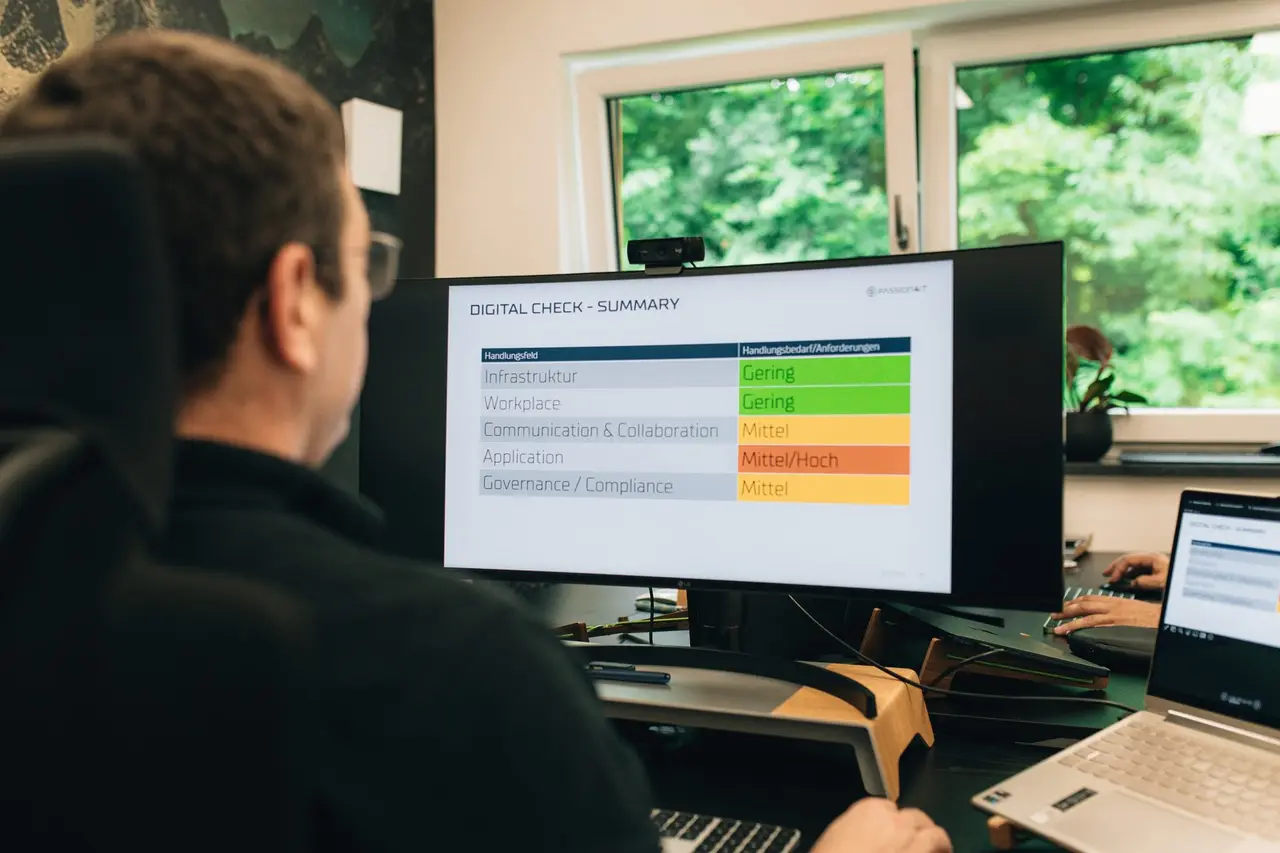
With a baseline assessment rather than a tool project. The Digital Check scores digital maturity across five dimensions and delivers a prioritised sequence — at a fixed price of 3,950 euros plus travel costs. In a fair number of cases the conclusion is that an analytics tool is not the next step but the one after.
That is not postponement. A reporting initiative built on unclean master data costs twice: once for the rollout and once for the correction. What such a baseline assessment costs in the market is covered in what digital transformation consulting costs.
Which funding routes apply to the consulting share?
The consulting share may qualify for BAFA funding under “Förderung unternehmerischen Know-hows”. The assessment basis is capped at 3,500 euros and the funding rate is 50 per cent — so at most 1,750 euros in Bavaria and the other western federal states, and at most 2,800 euros in the eastern states. PASSION4IT is registered with BAFA as a consulting firm under consultant number 222542.
Different programmes apply to the rollout of the chosen solution. Bavarian companies with fewer than 50 employees and no more than 10 million euros in revenue or balance sheet total can use the Digitalbonus Bayern: up to 7,500 euros under Standard, up to 30,000 euros under Plus, in each case up to 50 per cent of eligible expenditure. Applications reopen on 1 October 2026 and the directive runs until 31 December 2027. In both cases the application must be submitted before the project starts.
Frequently asked questions
Which consultants help mid-sized companies introduce data analytics tools?
The market offers implementation partners for individual vendors, pure data specialists, and vendor-independent consultants. For companies without their own data team the vendor-independent consultant is the right entry point, because they own the selection without earning on the licence of the system they recommend.
How do I tell whether a consultant is genuinely vendor-independent?
From three checkable points: what they earn on, how many vendors the process structurally evaluates, and what happens if no solution fits at the end. Anyone with no answer to the third has pre-empted the outcome.
What comes first, the tool or the metrics?
The metrics. Three decisions carry it: which decision should get better, which figure decides it, and who looks at it how often. After that the tool question is usually smaller than expected, because the requirements collapse to a handful of points.
Does data quality have to be right before choosing a tool?
It has to be assessed at least. An analytics tool does not improve poor data, it distributes it faster. If the same customer number is held differently in three systems, every dashboard delivers three truths.
What does a structured selection process cost?
It runs at a fixed price set before the engagement, following the scope: number of use cases in the script, number of vendors invited, and size of the jury. No day rates and no supplements for meetings already in the script.
What do I hold at the end of a selection process?
The script with the documented use cases, each vendor’s score against those cases by the jury, a reasoned recommendation, and the basis for contract negotiation. The script stays usable because it describes the requirements for rollout and later acceptance.
Is consulting on data analytics rollouts eligible for funding?
The consulting share may qualify for BAFA funding. The assessment basis is capped at 3,500 euros and the maximum grant in the western federal states is 1,750 euros. Different programmes apply to the rollout itself, such as the Digitalbonus in Bavaria.
How long does a software selection take?
The duration depends on three factors: the number of use cases in the script, the number of vendors invited, and the jury’s availability. In practice the jury is almost always the limiting factor, not the consulting work — which is why the schedule is part of the quote.